Free tool Genetics Lab · v1.0

Which enzymes work, and why the others do not
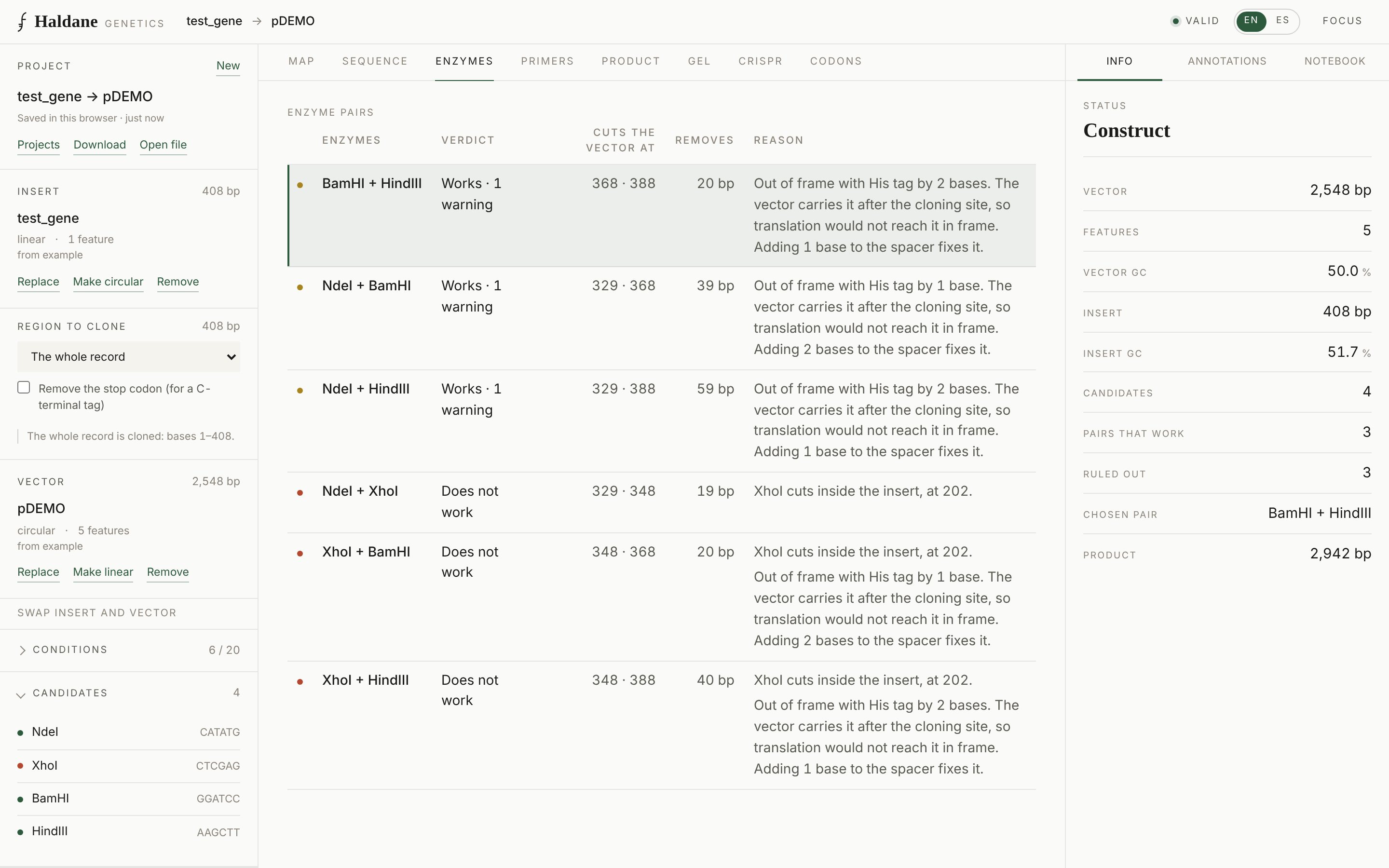
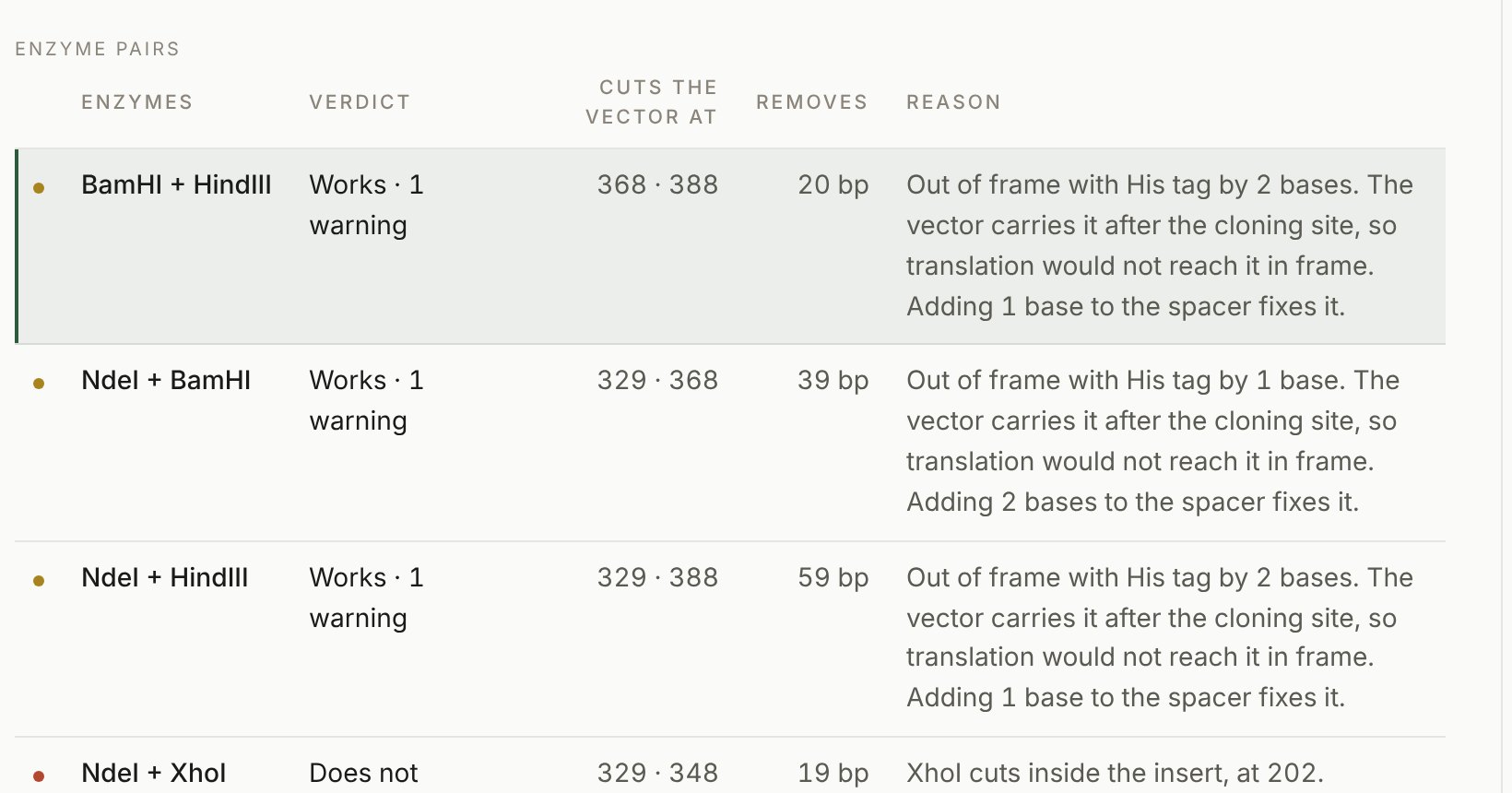
Table of enzyme pairs with their verdict
Every pair, with its verdict and the reason for the rejection

Restriction cloning design in the browser: which enzymes can take a gene into a vector and, above all, why the others cannot.

What it does

With an insert and a vector loaded, the tool evaluates every pair of enzymes in the cloning site and returns a verdict per pair. The ones that work are ranked; the ones that do not carry the reason in writing, with the exact position of the problem.

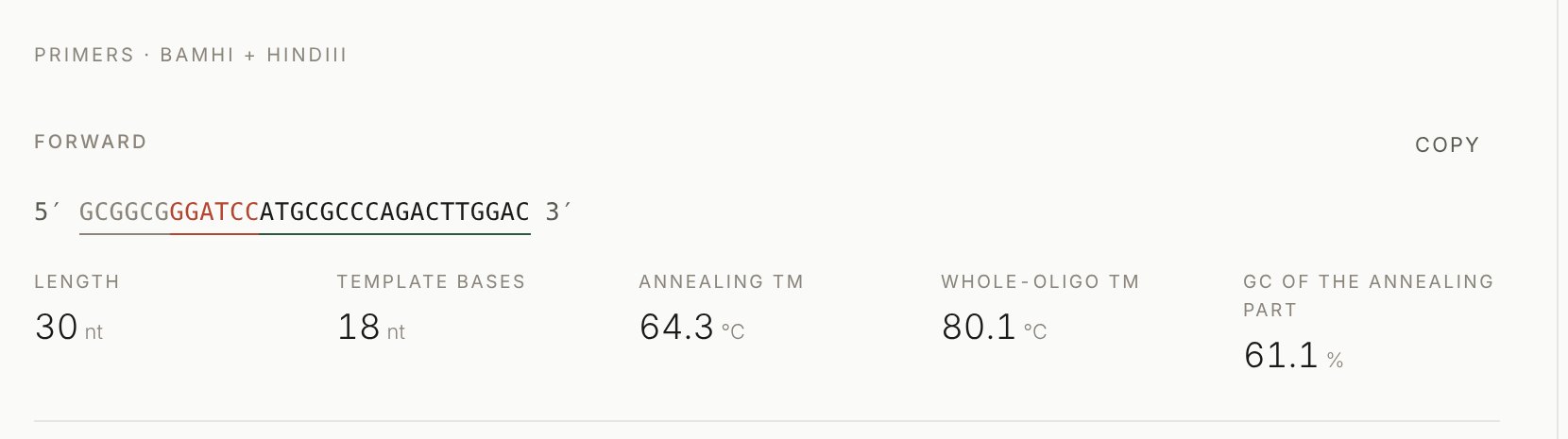
For the chosen pair it works out the primers (clamp, site and annealing region), their two melting temperatures, the resulting plasmid with its annotations moved into place, and the gel that should be seen when checking it.

It is designed for the step before ordering oligos: the moment when a design error has not yet cost a week at the bench.
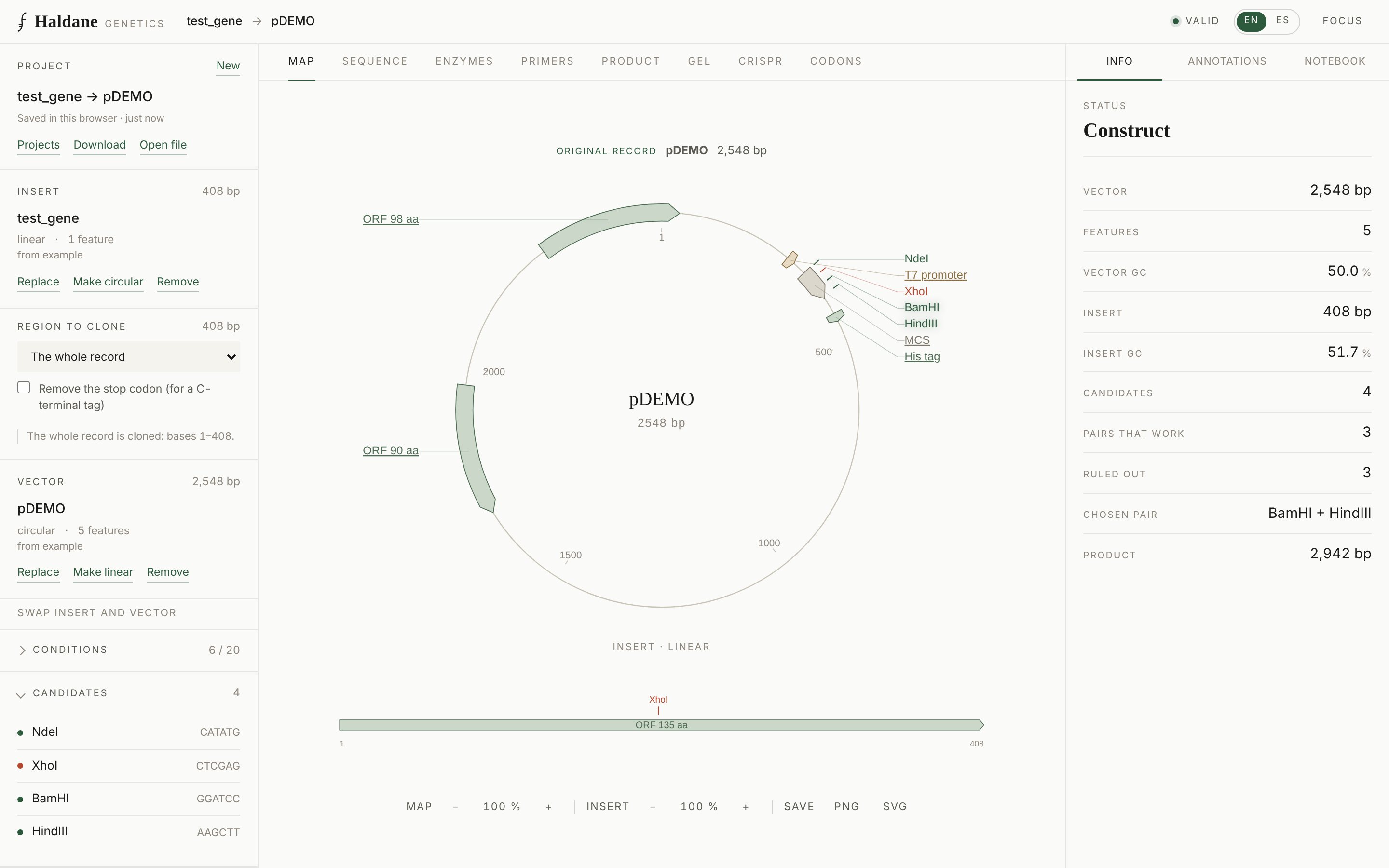
Plasmid map in Genetics Lab
The map draws itself, and the multiple cloning site is found by calculation, as the stretch enriched in unique sites, not by its name.

How it is used

  • The gene is loaded from a file (GenBank, FASTA, SnapGene .dna or EMBL), by pasting the text, with an accession number or an NCBI search, or from the last ten sequences used. Dropping it on the window is enough tooinsert
  • The vector is loaded the same way. A FASTA declares no topology: circular is assumed for the vector and linear for the insert, and it can be changed with one clickvector
  • The left column lists the enzymes that cut the vector once; the Enzymes tab shows every pair with its verdict and the reason for each rejectioncandidates
  • Choosing a pair computes the oligos, the final plasmid and the gel simulationresult
  • The product as GenBank, the primers as FASTA, and the maps and the gel as PNG or SVG. Every file carries a provenance block: tool, date, enzymes and conditionsdownloads
  • The interface is available in English and Spanish: it opens in the browser's language and can be switched with the EN/ES button in the top barlanguage

The work saves itself as a project inside the browser, and it can be downloaded as a file to open on another machine. The Focus button hides the side panels in any view, and the maps can be zoomed.

What it checks

Ten checks, in this order, on every pair of enzymes:
  • The enzyme cuts inside the insertrejects
  • The enzyme does not cut the vector, or cuts it more than oncerejects
  • The two ends ligate to each other, so the insert could go in backwardsrejects
  • One of the ends is bluntwarning
  • The same enzyme on both sidesrejects
  • Clamp bases are missing in front of the site in the primerwarning
  • The junction falls out of frame or introduces a stop codon, when frame checking is asked forrejects
  • The neighbouring bases form a Dam or Dcm site over the targetwarning
  • The two vector fragments do not separate on a gelwarning
  • How much vector is lost between the two sites in that orderinformative

How it is calculated

Forward primer with its two temperatures
Two temperaturesThe one for the region that anneals and the one for the whole oligo
A verdict for every pair of enzymes
A reason for every rejectionWith the exact position of the problem
  • Melting temperature by nearest neighbours, with the unified SantaLucia (1998) parameters and their salt correction. Magnesium is converted to equivalent sodium with the von Ahsen (2001) approximationTm
  • Two temperatures per primer: the one for the region that anneals to the template, which rules the first cycles, and the one for the whole oligo. Most calculators only give the secondannealing
  • Dimers between the two primers in both directions, and the self-dimer of each onedimers
  • Methylation by context: the tool works out whether the neighbouring bases of that particular sequence form a Dam or Dcm site over the target, and tells the intrinsic case apart from the one the context createsDam · Dcm
  • Multiple cloning site found by calculation, as the stretch enriched in unique sites, not by its nameMCS
  • Common features (ori, AmpR, KanR, the lac, tac and CMV promoters, among others) recognised by alignment with a minimum identity of 90 %24 features
  • Secondary annotations in a record, such as phosphorylation sites or interaction regions, hidden on the map but not deleted: they remain in the downloaded filesannotations
  • Checked input: anything that is not DNA is rejected with the reason, and every change made to a sequence is recordedinput

The gel simulation

There is no need to simulate a PCR and a digest separately beforehand. As soon as a pair is chosen, the tool already knows the vector, the PCR product with its tails and the final plasmid, and it builds the lanes from them: vector cut with both enzymes and with each one on its own, PCR product, final plasmid with the double digest, and the 1 kb or 100 bp ladder according to the sizes.
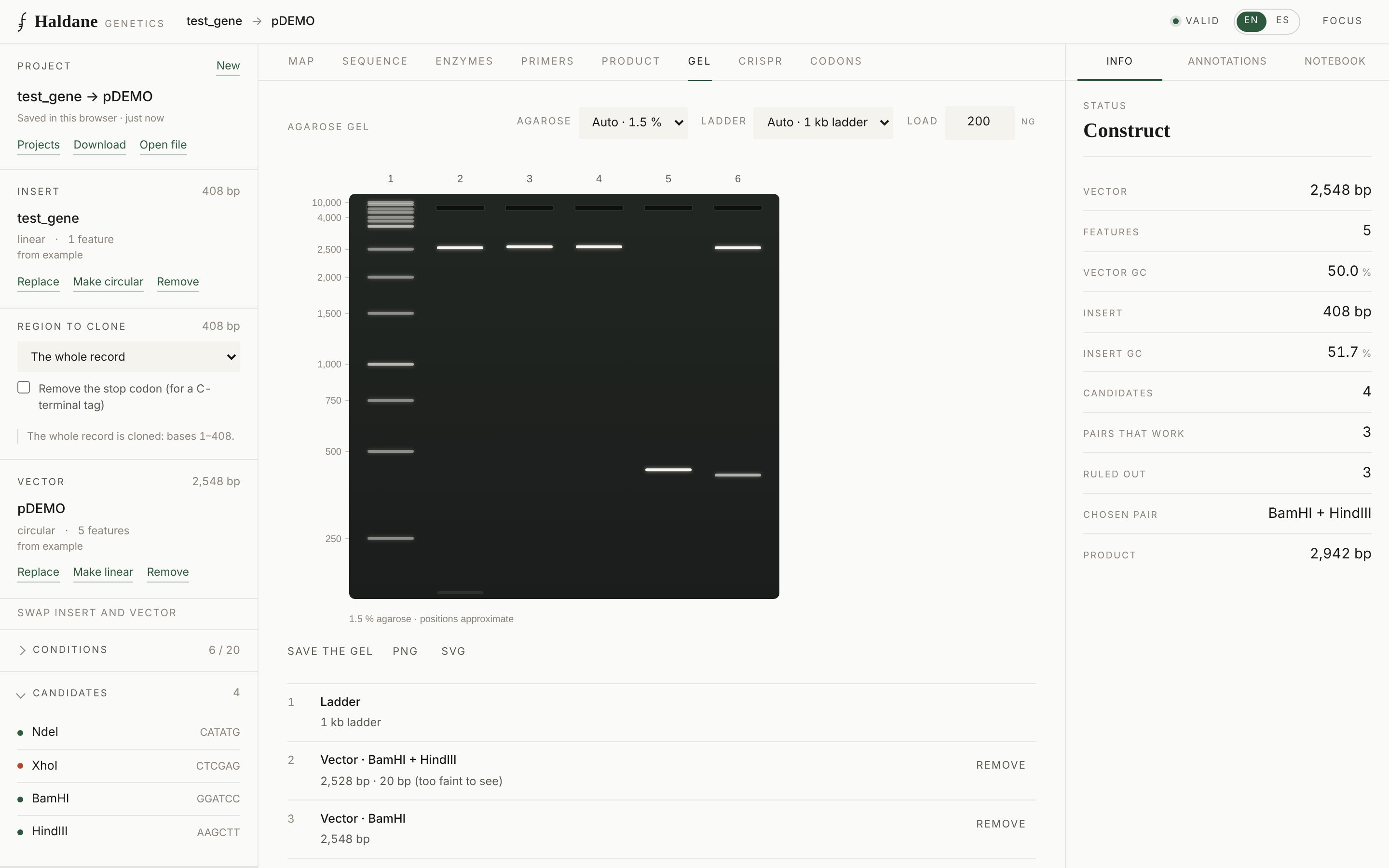
Simulated gel in Genetics Lab
Lanes can be removed and others added, with any combination of enzymes from the catalogue. The agarose percentage (0.7 to 2 %) and the ladder are chosen automatically or by hand.

Bands are placed linearly in log(size) within the resolution range of each agarose percentage (Sambrook and Russell), and whatever falls outside is compressed towards the well or towards the front.

Intensity is proportional to the mass of each fragment; two fragments that would run together are merged into one band, and this is stated. Uncut circular DNA is not drawn, because its position depends on its topology and not only on its size.

Privacy

Genetics Lab calculations and projects are processed in your browser. Sequences and projects are not included in browsing measurements. When public records are queried, the identifier or the search terms travel to NCBI.

Projects and the most recent sequences are kept in the local storage of the browser. Clearing the site data removes them; download your projects to keep them. Privacy — Haldane Genomics.

Limits

  • Restriction cloning and ligation of one insert into one vector only. It does not cover Gibson, Golden Gate, Gateway or In-Fusionscope
  • It does not consider buffers, star activity or how sensitive each enzyme is to methylation: it reports the sequence context, not the behaviour of a commercial batchreagents
  • The gel is an approximation: it does not simulate partial digests, supercoiled DNA or differences between electrophoresis buffersgel
  • The library of common features is deliberately small. Whatever it does not recognise is shown exactly as the file annotates itannotations

Results are a design aid. They should be reviewed before ordering reagents, and the final plasmid is confirmed by sequencing.

Licence and use

Genetics Lab is proprietary software of Haldane Genomics. Using it at haldanegenomics.com/geneticslab is free and requires no registration.

The files, maps and images produced with the tool belong to whoever produces them and may be used without restriction in publications, theses, reports or teaching material. Citing the tool is appreciated.

The source code is not public. No licence is granted to copy, modify, redistribute, host elsewhere or reverse engineer it, in whole or in part, without written permission from Haldane Genomics. The software is provided as is, without warranty of any kind.

Third-party data: the catalogue of 623 enzymes comes from Bio.Restriction (Biopython) and is distributed under the Biopython License Agreement. The thermodynamic parameters are published constants. No Addgene maps or NEB tables are included.

How to cite it

Jones, S. R. (2026). Omega Genetics Lab: restriction cloning design in the browser (v1.0). Haldane Genomics. haldanegenomics.com/geneticslab

For the melting temperatures, SantaLucia, J. (1998) should also be cited: A unified view of polymer, dumbbell, and oligonucleotide DNA nearest-neighbor thermodynamics. PNAS 95(4):1460–1465; and, for the enzyme catalogue, Cock, P. J. A. et al. (2009). Biopython: freely available Python tools for computational molecular biology and bioinformatics. Bioinformatics 25(11):1422–1423.

Questions, bugs or a specific cloning job: [email protected].

The other tool

E-Field Lab

→